Showing posts with label China Girl. Show all posts

Wednesday, October 12, 2022

Gossip on Guess Rd.

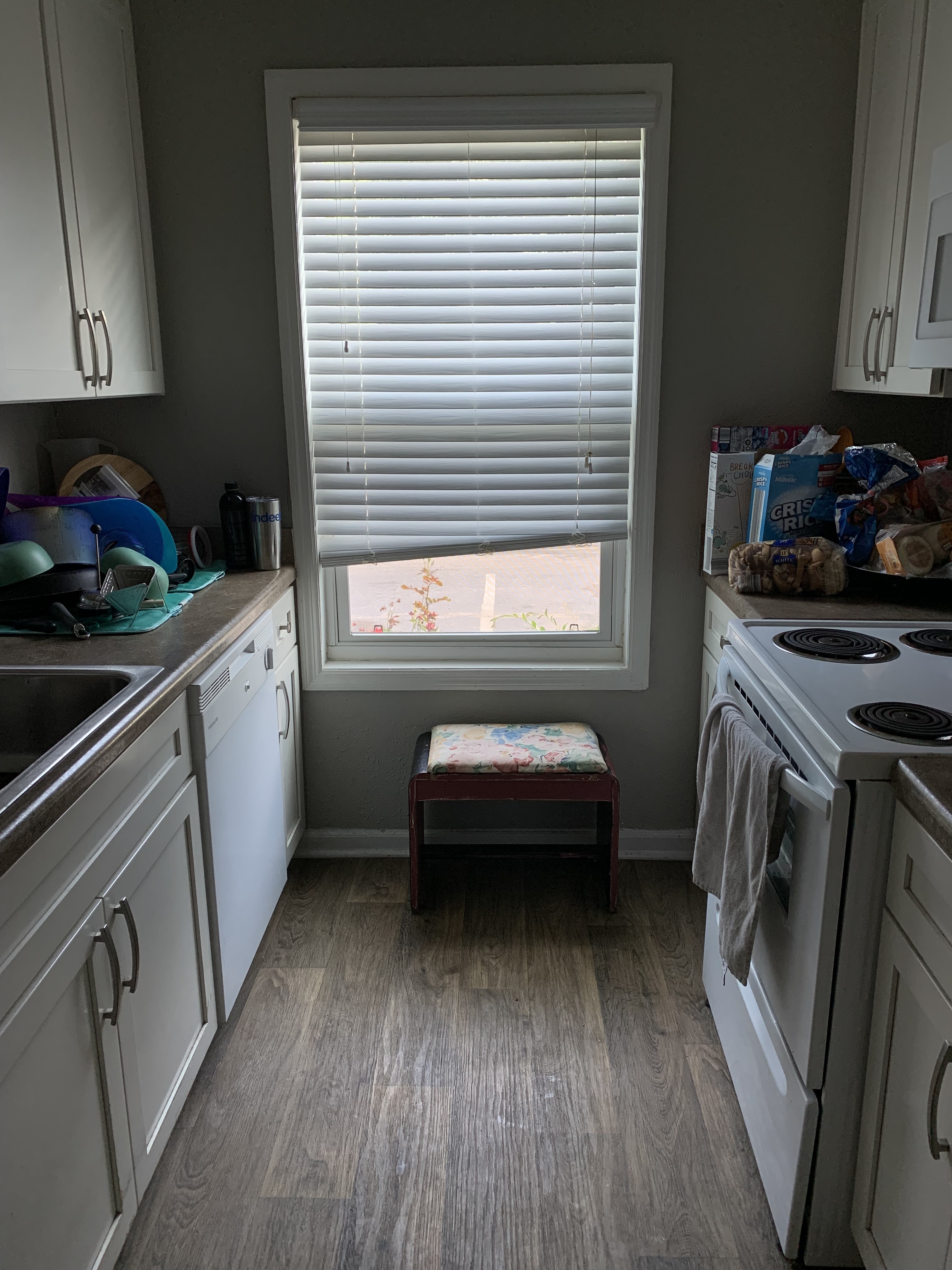
In humid areas of the world, bugs inside of homes are not a sign of uncleanliness. But our apartment was not clean, even before me and my stuff got here. The cockroaches on the floor were already dead. The cabinets looked like they'd been clawed by Rottweilers and there were cigarette burns in the linoleum. Smoke from cigarettes and weed was inlaid amongst layers of grey and beige paint. 

I subscribe to Architectural Digest magazine and I think on some carnal level, I hope to create a space as gorgeous as something they'd print. But as I was writing this, I had an explosively funny daydream about a magazine that featured apartments like the one we currently live in. Imagine Drew Barrymore caressing a bumpy beige wall talking about how after a year of watching her neighbors become homeless, she's learned to smile at the smell of weed because it's like the whole neighborhood truly deserves a respite from the shitty jobs they have. 

We chose this apartment complex from 2600 miles away because it was cheap and zoned for a public school we were interested in. The plan was to buy a house in the area and kill two birds with one stone by living in a cheap(ish) apartment that could double as a storage unit for our boxes. Within months of our cross-country move, we hadn't found a house to buy, and 1.5 years later, we still haven't. My feelings about this are laughy-cry-y. I have a strong urge to assure everyone that our delinquency as functioning adults is not our fault, and there's plenty of truth in that. I've spent a lot of time daydreaming about being somewhere other than right where I am. But slowly I've come to identify less as a person with means who will get out of here in time, and more as a person who does actually live here in the same reality of this neighborhood with my neighbors


These apartments remind me of my childhood homes in China. The entrance to our building here in Durham is similar to the entrances to the ubiquitous five-storied concrete block apartment buildings in China. The ones in China are modeled after Soviet buildings colloquially called Khrushchoba, a mashup of [Nikita] "Khrushchev" and the Russian word for slum. China adopted this post-communal design because the buildings are easy and cheap to mass produce. The sides of the buildings are prefabricated concrete, made to fit together like sides of a paper doll house. 

One thing that's always confounded me about those apartments and the one here in Durham too, is that the kitchens are so small. I think the people who design apartments think that two parents and 1.7 children will live there. Ironically, low income families across the world tend to have more children, relatives, and friends living with them, which requires multiple people to be preparing meals almost constantly. While galley kitchens are not my ideal, there is something to be said for being able to reach everything without moving, and being able to order everyone out of the kitchen when I'm cooking because there isn't enough room. No one would believe Drew Barrymore if she said she needed more space in her kitchen. 
In China, we lived in homes with mudbrick walls and no plumbing, neighborhoods swamped with open sewage, bars on the windows, and unstable electricity grids that caused lightbulbs to explode like little glass grenades. The confusing thing was that our homes were luxurious compared to many of our local neighbors, and hovels compared to some other missionaries. It was often embarrassing that we had so much or so little, depending on who our guests were. I find myself in much the same situation as an adult on a different continent. My parents were conscientious of their living choices in mixed cultural contexts, and did a wonderful job with that juggle. Still, they chose to live far below their means. I'm not convinced that my similar situation is as autonomous.   

I'm right on time for my appointment with mysticism as a Millennial exvangelical white woman, but lack of answers, resolution, and control is not tranquil. I'm probably the only moron who thought it would be. Living in the unideal present has given me a more realistic and depressing understanding of the castes of existence in the United States and all the rules that actively keep people from transcending the misery of poverty. I'm against the idea of "bad" neighborhoods, but the darkness and tension that permeates poor neighborhoods often feels bad. 

Exhibit A: Apt 315. I don't know how many people were living in 315, but one consistent character in that household was an older teenage boy. I had nothing against him, except that one of his buddies was trouble. The buddies came by in their car every now and then, and then they all stood down by the edge of the forest (which is mere paces from our building), and fired their gun into the trees. 

I was making dinner when I noticed flashing red and blue lights on the ceiling. I reached over to the window and parted the blinds to see three squad cars lined up in the street. An officer was talking to the teenage boy who looked like he was desperately trying to reach someone on the phone. An ambulance was already outside, but must have done its work (if someone went in to the ambulance, I never saw) and left soon afterward. The squad cars stayed and stayed, for hours. 

When I looked out again I saw a white crossover with lettering on the side. It wasn't the typical black and white paint job, it was rather inconspicuous. The letters said Crime Scene Investigation. Of course I recognize that someone somewhere must have the job of taking careful photos at crime scenes and samples and stuff, but it's one of those jobs that I've only seen on TV and therefore only existed in my mind as part of the world of TV. A man with rubber gloves on was rummaging around in the trunk of the car putting together an accordion folder of I'm-not-sure-what. It looked like drop clothes, but I couldn't wrangle a picture of their use into my image of the interior of Apt 315. Then he slung a nice camera around his neck and began taking pictures in a 360 degree radius of the surroundings of the building entrance. I wondered if my prying little eyes were captured between the blinds the way a cat's eyes look robotic in a flash of light. 

Then the CSI photographer walked into the building entrance and that's all the more I saw. Well, I did see that the teenager didn't seem to be in trouble. He was going in and out of the apartment, eventually with two overnight bags packed, and then he drove away. I didn't see the family's car for a few days, but when they were back, they had a U-Haul and were moving out. What happened in there? 

As I'd been watching through the blinds and putting together that something probably terrible had happened, I thought about going out there and asking if anyone needed food or something else we could offer during a crisis. In a previous chapter of my life, that was my job - stepping in to neighborhood crises with food or jackets or kind words or childcare at the ready. This time I just stood still. 

I thought to myself that if I went out there to satisfy my curiosity and offer assistance, perhaps I would discover what had happened and perhaps that would help me piece together the other clues I'd gathered about this family. Then I would be crushed by the weight of all that I could not do to help. All the help they'd needed leading up to this point that I could not give because I did not know them, and I didn't want to know them very much because then I might have something to offer, which means I couldn't not try and help, which means I would be sharing in their suffering on top of all the troubles I'm already facing. 


The smoking bench has been backed into by cars so many times that it belongs in an impressionist painting. 

Exhibit B: Apt 312. Inside my imagination live the lives of other people, painted in the color scheme that belongs to me. For a year, I knew the neighbors in Apt 312  only by sound (I never saw them), and the room in which they produce this sound lives in my imagination. The sounds I hear come from who I think is a child. The child is not like most other children of similar voice maturity because they do not speak but only shriek. They sound like a whale, their voice dipping up and down in a curvaceous and continuous line, or like a grade-school recorder flute as it distorts. Are they happy? Are they communicating an idea to someone else in the room? In the room as I imagine it, there is no furniture except a small table, and on the small table there is a television that keeps the child happy, or at least entertained, most of the time. Maybe they whoop when they see something on the screen that they like. The rest of the room, which is small but clean, is carpeted and there are high-pile blankets making hillocks of fuzzy rainbow flowers in every direction. I know this image is also transmuted from Tajik homes in China. The child's family is doting and inhumanly patient. They treat their child like the incarnation of a Hindu god. What saints they are, for I would only want to stop the blubbering of a whale. 

My perception of my neighbors is unsaintly. But part of writing, both fiction and nonfiction, is getting to tell stories about unlikable and imperfect characters, in this case me. I wrote the paragraph above last year, and have since learned that my shrieking neighbor is an adolescent boy with autism. In my limited interactions with him and his mom, they are both considerably more patient and loving people than I am. Just this week I heard them singing happy birthday, followed by a lot of excited shrieking. 

Exhibit C: Apt 306. The one family I had started to get to know had three or four kids of their own, and cared for several additional children. We met them last summer at the pool where one of Ishmael and Ira's agemates in their family hugged them in the pool, and the dad would catapult my kids out of the water along with his own kids, just like my dad did in the pool when I was little. We'd wave and chat briefly whenever we passed each other in the neighborhood. Their kids often played outside in the grass between our buildings, and I began inviting them to play games, draw with chalk, and eat graham crackers on our patio. The kids waved at me when I'd drive by. 

One day I waved at them and the little girl I talked with the most gave me a much less enthusiastic response than usual. She looked worried, I realized later. The next day as I walked home from the mailboxes, I noticed an orange piece of paper in one of the windows of this family's apartment. I got closer and saw that it was an eviction notice. All their belongings had been locked inside and if they came back to get them without talking to the management or the sheriff, it would be considered breaking and entering. I never saw them again. 

I still feel miserably sad about that family. Where did they go? There is nowhere in this city with cheaper rent that I know of. The kids didn't get to say goodbyes and probably didn't get to take any of their things when they had to leave. I imagined their pillows still in their bunkbeds and how they'd probably be destroyed when maintence went in to clear out the apartment. Somewhere out there, my little neighbor was missing that familiar pillow. It hurts me to think of how joyful that family was in spite of the struggles they were up against. The dad had a job, but they must have been unable to pay the rent for a long time to have gotten to the eviction point. Even if we'd known their situation better, we could not have helped out with that level of cash. 

Once I'd discovered the orange notice, I spent hours putting together a packet of documents about their tenant rights and other city resources for struggling renters, although the websites offering special COVID assistance had long since used up their emergency funding. I carried around that packet of documents hoping I'd see the family somewhere and could give it to them, but it was already too late. I wonder if the kids got to say goodbye at their school. 

Part of my deep distress over that eviction and the left behind pillow was that it feels familiar to my own childhood. We left so many homes to which there is no return, and with that came the same feeling I'd seen in the little girl when she was too worried to wave back at me. The loss of your connections, your friends, and the impermanence of stuff. Adrift in a scary sea of an adult problems that work actively to make life harder. Too young to have any power within that sea. Then we grow up and realize that if we're poor, we're still mostly powerless.  

I have one picture of those kids that I'd taken when they were playing on our porch. I printed it so that I can say goodbye to them as many times as I need to. 


Exhibit D: Apt 318. When we first moved in, the neighbors in 318 were dealing drugs and jumping over live fireworks. They eventually abandoned their apartment and all the stuff in it. But they were the friendliest and most generous people to live in their building since we've moved here. The current neighbors in 318 arrived around a time which makes me thing they're Afghan refugees, but some other aspects make me wonder if they're Pakistani by way of Afghanistan. They aren't friendly, but I think it's because they're scared, and I don't blame them. I worry about them when I hear the old woman's deep cough or when bombs burst in air during the 4th of July. 

The young woman of the family sits near the mailboxes for hours in a jacket in Southern summer heat, talking to friends or relatives in other countries through the earbuds attached to her phone. Most of their belongings are probably donations from churches or relief funds. Someone gave them a 1970s rainbow sheet set that is coveted by vintage sellers, and I always think about that when I see it drying on their fence. Recently a young boy in the neighborhood was throwing large rocks and otherwise trashing the patio of the refugee family. So Jonas and I sit on our patio and wait for the kids to come by and then chase them away. It makes me delight in being an adult that my stare is enough to put fear into beastly children.

Exhibit E: Apt 319. These neighbors are chaotic. Once I had the distinct and amusing pleasure of overhearing someone in that household come out on to their balcony while on the phone, trying to convince a girl to continue their relationship. The caller made an impassioned case for why this girl should come back to him instead of be with some other guy, and the reasoning was mostly a list of the sexual pleasures he'd provided in the past, and how he could perform these things better than the other guy. She hung up on him. 

Someone else who lives in that apartment must be a student in beauty school, because sometimes there's a disembodied mannequin head floating on their porch, or a drying wig flung over the rail.

Plastic play food ends up in the grass below their porch, but they never come pick it up. The kids are young and cute, but often the recipients of a great deal of shouting, along with the weepy eyed little dog. When the kids cry, I want to go far away so I can forget the hurt playing out in someone else's doorway. As a child in China, I remember hearing a woman being beaten through an open window and when I told an adult (not my parents) what I was hearing, they said there was nothing we could do and it wasn't our business. I never know how involved I should get when I overhear yelling or hitting. I think of times when my own sons have screamed or sobbed, not because they were hit or yelled at, and thankfully no one took it as a sign to call the cops on us. 

Exhibit F: Everything, Everywhere, Forever. As far as I know, Drew Barrymore is actually a lovely person. She probably smokes pot, even though her house probably doesn't smell like it. I don't like the smell of cigarettes because I smelled SO MUCH of it growing up in China, and I don't like the smell of weed probably because I never smelled it growing up. I still don't like the smell, but I appreciate it a lot more than I did before I moved here. It's a smell that's becoming part of my sense of home and community. 

I've learned that the history of weed in Black culture is often a salve for sorrows. It feels as if the long history of criminalization was really just a way for the powerful to say, "we want you to stay poor, and hate it." No opiates for the masses allowed. When I see my neighbors in a cloud of smoke, I respect that moment. I want them, and me, to have those moments where troubles fade into the background for a minute and we remember the treasured things in our lives in spite of all the circumstances that could and sometimes do lead us to hate being poor.

Almost all our neighbors have bleak backstories, at least from my vantage point. Maybe I do too when the neighbors are observing us through the blinds. I wonder if they wonder why I'm always carrying small plastic groceries bags of clothes in and out of our apartment. The pains of these families are evident through the walls and closed doors, but each of us is too beaten down to take on more pain that isn't our own. The gap between the way things should be and the way things are is ever present. It requires a herculean effort to believe that anyone cares, because that's not the evidence before us. 

The apartment management can be low-key despotic with their arcane rules coupled with wild incompetence and ridiculous fees. The pool is this entire microcosm of American disgraces, in which the powerful control the overtaxed. It's like the management waits for dark-skinned children to punish for breaking arbitrary rules while praising light skinned children in the same breath. I clench and unclench my fists. My nails have grown long and strong, fortified by the sunshine and hair dye, painted to match the water. I silently pretend I'm the guardian of children who obviously aren't mine so that they can stay in the pool. I worry silence isn't enough. The management seems despondent at being on the premises, and superior when they leave in the afternoon to homes in other neighborhoods. 

Not everything is depressing, sad, tense, or exploitative. In what some people call bad neighborhoods, there is also joy and resilience. Families barbeque outside together. Tweenagers do TikTok dances in the pool, admiring their own fresh bodies. Men zip around helmutless on their scooters, sometimes giving kids a ride. Our kids trade Pokemon cards with other kids. The cicadas look prehistoric and their cries to mate haven't lost their magic. 

The summers here are everything summer should be. When Ira fell asleep next to me, his breath went in and out with a noise that sounded like a shriek followed by a sigh, "freeee-domm, freee-domm, freee-domm." Our tans deepened to the point where our body hair gleamed in contrast like a metallic weft. Cockroaches lay lifeless and papery on the patio, resembling an overturned container of medjool dates. 

Nearby, snakes entangle themselves in a thicket of Bojangles wrappers and exotic vines. It is the kingdom of frog fairies and the occasional cat, sleek as a sheik. I stand a safe distance away on the steaming asphalt, like molten lava recently congealed. Above our heads, a building has misplaced a vent covering, leaving a hole in the bricks that looks like a giant flared nostril. My memories of summer in the cool concrete shadows of Khrushchobas are similarly some of the most vivid and cherished that I have. 

A line from Elif Shafak's "Three Daughters of Eve" struck me. It reads, "Peri would come to understand that nothing swells the ego quite like a cause motivated by the delusion of pure selflessness." I've tried to describe our living situation as something I'm grateful for, something I recognize as subpar for everyone involved, and as an opportunity to learn from and immerse myself in without a savior complex. It's messy. 

Choosing to give generously (money, time, emotion) can be challenging. Choosing to suffer systemic greed is delusional. A big moral dilemma since living here has been balancing choosing to help as I'm able with not liking it. What does it mean about me that I care and I help (sometimes), but with a grimace? I have lost the delusion of selflessness. Which is a great thing. Charity costs less than solidarity. And while chosen solidarity is valuable, unchosen solidarity lasts longer and isn't half as suspicious in "bad" neighborhoods as charity is. There is no glory in unchosen or imposed destitution. When we move away some day, I won't miss this apartment or this neighborhood. But I will remember that we learned to call it home. 

_____________________________________________________

Parts of this essay appear in a different format in this anthology. 

Wednesday, November 7, 2018

Old Things Made New

Recently, China has become a part of my day-to-day life again. I started tutoring in Chinese (which happens to involve cooking Chinese food once a week), I'm reading a book about China, watched a very long show in Chinese, and I'm considering applying for work teaching Chinese students. Suddenly, I'm thinking in Chinese again.

It feels good in a way I'm not quite able to articulate. It's not exactly happy or exciting (though it's not not those things), nor is it purely nostalgic, because it's not a repetition of the past. New words, new books, new ideas, new insight, new faces. It's not exactly something that's always been there, because it's specific to this point in time. Maybe it's like a piece of clay that I carry with me. It's always there in a formless state, but it's not alive nor does it carry specific meaning unless I put my hand to it and shape it.

I like the way Chinese sounds. Familiar, but also with infinite unexplored corners. I like picking it out in a crowd, like a code that most people can't decipher. When we were out trick-or-treating last week, I heard a man on his cell phone, saying to his older relative on the other end, "how are your eyes?" These moments are like being brushed with the beam of a lighthouse, directed at me. I like being able to speak a second tongue without effort, even if I rarely use it. Like an old locket that's always around my neck, but hasn't been opened in a long time. It's like opening the door of your home after a long trip away, and recognizing its smell that you can't decipher when you've been living in the midst of it. The rooms are the same, but you have changed. You walk through the house and you open the windows. A fresh breeze shifts the scents, not unpleasantly.

(W.T. Benda)

I am wary of ever saying I've healed from something. Healing seems to be a key that unlocks new doors that held previously restricted areas in need of healing. I am wary of saying that reconnecting with part of me that wants to be steeped in a Chinese life is a turning point, rather than a blip.

Sometimes I think TCKs (Third Culture Kids) are afraid to be healed. What are we, without the special concoction of pain and lack-of-belonging and misunderstood-ness and identity crises that we all recognize and embrace as our Third Culture? It's a beloved culture and it's something that gives us a place with one another, so what will be left to feel if we whittle away the sharp edges of that community bond? The sharp edges that poke us into remembrance, even if the memories are painful? What is left to understand if not for being misunderstood? What is to be shared if not for a sense that no one can fully share with us?

The good parts of being a TCK are often specific to the cultures that make us up. The bad parts are universally understood by TCKs. So I'm stuck thinking that:
To heal is to let go.
To let go is to forget.
To forget is to lose my identity.

Therefore I must not heal entirely.

I know there are flaws in that progression, but it's my perception. I've gone through that process to a degree and simply built a new identity. I am rooted in America now. I don't always think of myself as American in the same way that non-TCK Americans are American, but America is my home now, none the less. That's why sudden immersion into Chinese customs and thoughts and entertainment and language has me...unable to define how I feel about it. It might be healing. But it might also be ripping off a scab. Re-breaking a bone that didn't set correctly. I don't want to break, but I do want to heal.

I've wanted my identity to be in the homeless, stateless, wandering community where I understand the terms, bitter as they are. But it's purgatory. It does not sustain full life. If I am a tree, I wanted my roots to suck life from both sides of the ocean, but I simply am not big enough to do both well. And to let one half of the roots thrive means letting the other half wither. And it's a dreadful thing to choose. For a tree to grow, it must allow its roots to run deep.

I don't know if I can do it, or if it's a one time decision at all, but maybe China is a place that can be a part of me going forward, not just always looking back. Maybe I can let go and grab on anew at the same time. I will inevitably forget things, but maybe also remember a few things, and make new memories that are informed by a foundation that is blurry now. Maybe I can identify myself in a realm that encompasses more than loss of things I've loved. 

Thursday, May 31, 2018

Diary of a Sad Lady

Despite my hopes for instant and wild fame as a result of blogging, it's always been something of a personal journal. A journal is a place where you don't have to have all the answers, you won't be graded on how well you argued your point, and it's okay to not have a point at all. I don't have bullet points today, and if I don't feel hopeful at the end of writing it, then I just won't end on a hopeful note.

I do love it when people give glowing reviews of whatever I have to say or I get praise for being "so honest". But it's not an achievement for me. There's always another layer I haven't reached or shared yet, not because it's too dark or too personal, but just because I'm a work in progress. In my mind - most days - I Have Arrived. The way I am is the culmination of everything I've said and felt and been and done up until now and I can't be any more than that. But I forget that tomorrow will add to that and I never really Arrive at the final version of myself. I've had everything worked out since I was 5, and it's a continuous irritation that I'm just not developing according to my master plan.

Rather than having arrived at Butterflyness, I think I'm more like something freaky emerging from a chrysalis. And my hips are stuck. I went in fuzzy and I'm coming out... still fuzzy. I'm beginning to realize that my butt just might not look at all like what I'd imagined. Figuratively speaking.

I'm sad. And I know it. And I don't know how to go through it instead of around it. Even if I knew how, I don't want to. Most of the time I'm not sad, but sometimes things happen that I can't prevent and that makes me recognize that little by little, I've made choices to insulate myself from feeling sadness. When that insulation gets chipped or threatened, I get a little twitchy. A lot twitchy. So twitchy that I've started to recognize that even though I don't know what it is that I'm suppressing or why it's there, it's something that I'm afraid of letting it out because I certainly recognize its magnitude.

In my waning ability to control this thing, I've noticed that I'm manifesting some neurosis, and that startled me. The most notable thing is that it's become increasingly difficult for me to drive. I've never been in a real accident, but my inability to control other drivers while I'm driving or the idea that anything unexpected could happen at any moment makes me extremely jumpy when driving, and I get sweaty and feel tingly. When I reach my destination I feel an inflated sense of relief. I've even begun to avoid some travel because I'm too stressed by the journey to get there. I think I will actually just get a little too sad right now if I explore how my must-control-my-environment coping mechanisms affects how I relate to my children. Sometimes I don't let them talk in the car.

Unresolved sadness upon unresolved sadness has built up into something that feels insurmountable. My family often asks me why I "bottle up my feelings" and I always deny that I do, because I certainly don't do it consciously. I have a lot of feelings and I express plenty of them. I recognize that "bottling" is not a good thing to do, and therefore I would never willfully ignore something that needed to be dealt with. But I guess that's the whole point - somehow I fake myself out of thinking the hardest things are worth dealing with, and that is by nature burying it.

If you're wondering why I'm sad or how I got to be cripplingly sad, I couldn't really tell you. I loved my childhood, but it was a never ending cycle of ended relationships and I was not in control of when I got to say goodbye. Or if I wanted to say goodbye. It's no ones fault, but it was sad then and it's sad now. There wasn't any use in fighting it and no one who deserved my wrath, so I never fought it and I didn't take it out on anyone. But fighting is part of grief, and since I never grieved, I guess I just skipped all the emotional work that's necessary when you experience something sad. Now, when I experience something sad, I don't know how to accept the sadness and it leaks out of me in other ways, like my control issues. And there's so much pent up sadness that is pushing against the back of my eyeballs whenever something even a little bit sad happens that it would be a disaster to let it all out over something that isn't worth a tsunami of feelings over. Sometimes, I've wished someone (no one in particular, calm yourself) would die so that I had an appropriate occasion to really lose my shit all at once.

I never really understand that whole "Instagram looks so perfect, but don't believe that perfect life" refrain. I'm not covering up a dark secret with images of my beautiful life. My life is actually beautiful a lot of the time and I'm not trying to pretend that I don't have problems. But then when I get to a place where I can even consider that I might be detached from part of my own being... well, how does one casually bring that up on Instagram or otherwise. Flower photo, vintage outfit photo, cooking tip, my kids looking cute, more flowers, oh by the way my mind and body are conspiring against my commands as a result of Unresolved Grief. Do you like my dress? I do.

In acknowledging that I have some emotional trauma buried that I need to process, I've had several people recommend that I develop a compassionate inner voice. I'm trying not to blow that off as the bougiest thing I've ever heard because the whole point is to acknowledge that maybe I am repressing something and I'm aware that I'm not currently equipped to handle the exorcism. Therefore, logic would dictate that I might need some new tools to help me. I have a few, but I'm not ready to use them yet. 

Am I mean to myself? I mean, not that I know of... but on the other hand, would a she-devil that's always been a she-devil know that there was any option out there but attack with fangs? As ironic as this is, I don't really want to bad-mouth my inner voice because she is... me. My inner voice chamber is where I don't have to filter the way I encounter the world in order to be polite. Yeah, inner voice can be sassy and ruthless, but so is reality.

I want to tell Inner Voice not to tell me to be nicer, because when I'm in pain, I don't want to be nice. And I don't want to feel guilty about having that space where I get to lash out without verbalizing my most wretched desires and dreads. I like a place to contemplate crimes without having to commit any. I also don't want Inner Voice to give me any bullshit about how the blackness of my heart will eventually come out of my mouth because that's what the Bible says will happen. Inner Voice right now to hypothetical Inner Voice telling me stuff I don't want to hear: "I know, dumbass, I can read." She's rude and mean. So am I. But she's also as honest as she knows how to be and recognizes when things suck and it sucks to feel them. And I don't want to nicen that up. I rely on cynical, angry voice to help me process things that I don't like. I guess I just don't know how to tone it down when I get past the angry phase.

I also don't want the internet to think that I don't have "real friends" with whom I can discuss these more troubling things with. I do have wonderful in-person friends. But sometimes I don't talk too good out loud and I have to wait for someone else to respond and Inner Voice has to be tamed for the sake of human relationships.

When I think about the idea that internal stress that I don't acknowledge affects me physically and in some really strange ways, I just want to watch myself as a bystander. I mean, how WEIRD is that driving thing?! If it was someone else telling me that, I'd think they were making it up or making a rather far-fetched connection, though it must be said I'm notoriously bad at connecting causes and affects related to my body. I just don't have the time to figure out if cheese makes my stomach uncomfortable. Even if it did, I'd still eat it. Things that don't fit in to my personal logic structure just get relegated to "must not be real".

I only experience one reality, personally, but I'm much more open to the idea that there is no such thing as one static "reality" than I used to be. I have my own reality, but the more I think about it, the less it worries me if someone else who is "crazy" believes they're communing with aliens and stuff. I mean, who am I to say they aren't? It's real to them. And I really can't prove that it's not real. Imagine how frustrating it would be if you really were an alien and no one believed you. Anyway, that's tangential, but being that this is my journal and all, I can acknowledge any number of realities that I want to. Who knows what other weird stuff I might do in the future as a result of... I don't know...anything?! The more I recognize my own illogical, inexplicable self, the fewer assumptions I make about other people's "crazy" behavior. I'm not sure why I even value "having it together".

Relying on an environment I can completely control is I think partly why I've stopped writing very much. It's too draining for me to process other people's responses or to second guess my own thoughts and feelings about things. I don't want to explain myself any better than I already have. I don't know if it makes sense, and if it doesn't make sense to someone I don't want to work harder to explain myself. I am releasing myself from explaining why I have the urge to share everything on the internet too (thanks, Sweet, Sadistic, Inner Voice). It's because I'm a really gifted, brilliant, funny, mostly always genius and right writer, okay. And the world deserves to have my sparkle rub off on all its peasants.

It seems to me that most men have a sense of self assurance. The other day, I heard a man praised as "someone who never second guesses himself". I was starting to envy that belief that one is always right, until I remembered that it takes a lot more courage and work to consider that you might be wrong. Someone who never second guesses themselves can never listen to criticism. But I listen to all criticism because I believe other people's words (usually) have value. I think that's mostly a good trait, but it becomes deafening sometimes.

I've been reading Pearl S. Buck's autobiography (My Several Worlds) for a long time now, and this passage really stuck out to me:

"[I was sent several pages of blistering rebuke over The Good Earth because] I had been so frank about human life... The worlds in which I have lived and grown have made me what must be called a controversial figure, as I have been told often enough, and this is because inescapably, by experience and nature, I see the other side of every human being. If he be good, then there is that other side, and if he be evil, there is again another side, and if the ability to comprehend the reasonableness of both seems confounding to those who are content with one dimension, to others as to me, it is an endless source of interest and amusement and opportunity for love and life. We have no enemies, we for whom the globe is home, for we hate no one, and where there is no hate, it is not possible to escape love."

This perhaps proves that my Inner Voice needs a makeover, but the only person I can't argue both sides for is myself, to myself. My own dualities can be so destabilizing that I end up feeling confused and even angry with my inability to figure myself out. I can't help but encompass everything all at the same time. I don't view myself as controversial, I'm just a giant umbrella that is inexplicably compelled to present you with every option you haven't thought of every time you open your mouth. I'm not mentally unstable (well, not very), I'm just too small a vessel to carry all the things that I've absorbed and if you don't understand that innately, it makes me overheat in an effort to HELP YOU SEE BEHIND THE CURTAIN. I'm a sad, confused droid that wants to help people but only knows how to communicate in droid-speak. So kind of like a not-very-helpful thing that wants to be helpful.

I don't like this. I am a strong, grown-ass woman who is usually proud of herself and is good at things and I'm not happy that part of my own team is sabotaging me with it's crazy psycho drama that is part of me but also not listening to me and YOU WICKED DEMON SADNESS MONSTER JUST STAY IN YOUR BOX. I've been doing quite well telling my feelings when and where to feel, and I have no intention of letting them run the show. This is not a democracy, it's a dictatorship. My subjects are getting cocky with their insubordination and their feeling coup d'états

Are there rehab facilities for sad people? Where you can go and kill stuff, followed by a quiet soak in a scalding bath in a pitch black room? With dessert afterward? Maybe a Japanese mafia spa.

Inner Voice says I am not brave enough to get my weird fuzzy butt out of this chrysalis.

{images: Picasso, Priscila Furtado, unknown}

Saturday, April 21, 2018

Navigating Cultural Appreciation and Appropriation as a Global Citizen

As I was scrolling through Instagram stories today, a designer I follow had a reminder to "please be respectful of Mexican culture instead of mocking it in light of Cinco de Mayo coming up." I immediately panicked, wondering if I unwittingly show disrespect, since I couldn't imagine how one might celebrate Cinco de Mayo in a mocking way. I wrote the designer and asked what she considered disrespectful and she mentioned drunkenly imitating Mexican accents while wearing sombreros, and thankfully I've never done that or even considered it.

That experience of worrying whether I'm inadvertently appropriating someone else's culture is common to me. I think about the topic of cultural appropriation often because I know it's real but I also know that the rules of what is or is not appropriate shift and are nuanced depending on many factors. I wanted to offer my take, particularly as a Third Culture Kid (TCK) or a "global citizen".

I am ethnically/racially white from every angle of my family. My skin is very, very white. I spent the first 16 years of my life in various areas of China (which has a much larger degree of cultural diversity than is generally portrayed) and occasionally Thailand. Now I live back in the US where more than half of my city is Hispanic/Latino. That leaves me with cultural influences, appreciations, and background that do not match my ethnic background. This is common to all people with transient childhoods (or extended periods of adulthood) and to immigrants. More and more, the experiences that shape our personal and familial cultures are a blend of more than one ethnicity or tradition. Yet in cases such as mine, you'd never know if you didn't ask. If I wear Pakistani clothing while living in California and speaking English with no accent, for example, your first guess about why I might be doing that might not be that I grew up among Pakistanis. It might look suspect, but I still engage in cultural practices or decorate or dress up in clothing from other cultures because many of those cultures have become part of my identity.

Playing dress-up at home in Xinjiang, China, c.1995. Definitely not culturally accurate of any one thing, which seems like a great metaphor for the rest of my life, haha. 

I don't think there's a rule book that works all the time for what is or is not cultural appropriation, but here are some of my suggestions.

Appropriation vs. Appreciation
verb
əˈprōprēˌāt/
  1. 1.

    take (something) for one's own use, typically without the owner's permission.
    "his images have been appropriated by advertisers"

    synonyms:seizecommandeerexpropriateannexarrogatesequestratesequester, take over, hijack
verb
əˈprēSHēˌāt/
  1. 1.

    recognize the full worth of.
    "she feels that he does not appreciate her"

    synonyms:valuetreasureadmirerespect, hold in high regard, think highly of, think much of

Even though I understood the concepts of both appreciating and appropriating, I found these definitions to be insightful. Appropriating has this aspect of power-plays (addressed later on) and even violence. The image of a hijacking is an especially vivid association as we can imagine how jarring it would be to be going in one direction and have someone suddenly wrestle that choice away from us and take us in a new, unwanted direction. Similarly, appreciating means something more profound than the way in which I often use it - it carries this deep sense of worth, synonymous with treasure. I was especially struck by the definition of "recognizing the full worth". That's a true litmus test for whether we are appropriating or appreciating something.

I treasure many things. It's called being a maximalist, aka a trash rat. I literally find other people's trash and nail it to my walls, and it brings me great satisfaction! I've found that because of my messy cultural background, I like a lot of different things that have meaning or hold memories for me. Even if I don't have a specific memory tied to an object, I might see an object that reminds me of something or somewhere or even someone I love, and then I want to add that object into my living space. I am also interested in a lot of things that I don't yet "recognize the full value of" but exploring things that intrigue me is a way that I learn. A lot of items that I'm drawn to have an ethnic feel because I like color and pattern and faintly macabre stuff (carvings and masks) and that happens to overlap with many tribal, Eastern, or South American cultures. I find that I also search for things to attach meaning to as a way to compensate for not having strong cultural and spiritual markers within my ethnic heritage. That tendancy can easily become appropriation, but it has everything to do with your motivation, attitude, and experience.

I'm not sure I do appreciate the full worth of every thing I bring into my home or put on my body, but I do believe things have worth and that I add worth with my care for them. When reusing and recycling (thrifting), it's almost impossible to know the history of an item and what it meant to the previous owner. In that sense, we might never appreciate something in the way that it was first appreciated or designed to be appreciated, but at the same time, we have the opportunity to actually add value through a new appreciation of that item. I never want to seize something - an idea, an object, a look - that belongs to someone else, but instead to treasure things that I'm drawn to, even if the reasons I treasure them are different than what they were originally made for.

Create vs. Imitate
One way in which to avoid appropriating is to focus on fusion or mixing and matching. As someone with ambiguous or mixed up or layered cultural makeup, I'm typically drawing from and creating things - food, outfits, spaces, thoughts - that aren't purely of any one culture. Honestly, is anything culturally "pure" in our world? I don't think very many people would argue that being inspired isn't a great thing or that cultures don't borrow from each other in order to improve or adapt all the time!

However, to avoid making an imperfect homage to a culture or custom that I don't fully belong to, I create something distinct. For example, I found a long, red piece of cotton at the thrift store that has silver trim on each end and mirrors sewn on to it in several places. This is likely part of an Indian or Pakistani outfit. Instead of trying to wear it like a Pakistani women would (I did not find matching pieces when I bought it, anyway), I might use it as a bed canopy or a headwrap or a shawl with an evening dress (probably not an evening dress that is distinctly Central or South Asian). Being too "on the nose" with cultural imitation or appreciation can easily look like mockery to others, even if you have the best intentions. Trying to create an exact copy usually only highlights that the effort is a poor imitation. In my opinion, you can't get it "wrong" if you make something that is new, because you're the only person who's done that before, so there is no blue-print to misinterpret.

Adding something with cultural significance into a mix of other things isn't meant to veil that item's cultural significance by taking it out of context, but instead to weave it into my own identity without being costumey or running the risk of looking like I'm mocking someone else's heritage. I'm creating something new with pieces of many different things rather than imitating something that I can never fully identify with. This happens quite naturally with food because food is so tied to location by its very necessity. To truly recreate a Turkish dish, for example, I would need access to lamb in some form other than ground meat and a variety of spices in raw form. Neither of those things are easy to come by in my area of California, so I substitute and tweak. Sometimes it's sad that I can't perfectly recreate something, but at the same time, I end up making something new that has a piece of California in it, and that new fusion is distinctly mine. I don't pretend that it's perfectly Turkish and it certainly isn't native to California, but rather than degrading either of those labels, I hope that it elevates a new, third category.

Photo: My friend Karissa M. grew up in Cameroon and now carries her daughter in traditional baby sling (photo used with permission). 

Thoughtfulness vs. Consumerism
I've already stressed the necessity of being thoughtful about how we incorporate culturally significant objects or practices into our lives, but I wanted to talk about consumerism for a minute too.

There's nothing wrong with buying things that originated in other countries or cultures. We often want souvenirs of our travels, and sometimes we buy items to support the artisans that make them. In many places, selling craftwork to tourists or international markets is a main source of income for people. But I do get uncomfortable when craftwork is treated as a souvenir, in the sense that now we think that object belongs us to (because we paid for it) with no strings attached and we can be flippant about it or toss it aside when we clean out the house in a year or two. If you buy something when you travel, be willing to pay good money for something that's truly a work of art, and then treasure it for what it's worth. Don't buy junk (or treat your souvenir as junk) just for the sake of having visual representation of where you've been.

It's also makes me a bit uncomfortable when we see ourselves as benevolently lifting up "poor artisans." I'm not saying that there is no place for supporting ethnic craftsmanship, but please do so with dignity instead of out of guilt or a belief that someone else's livelihood depends on your kindness. I heard a story recently in which people who had had Western missionaries move to their area were asked about their feelings toward missionaries. The missionaries who were respected were those who treated others as equals, not as students or people who were in need of something that the missionary had. One missionary mentioned in the story had a family emergency come up in his home country. Unable to pay for a ticket home, he asked for help from the people he lived among, and that really made an impression on them, because that's how real friends treat one another - not that one party is always the giver and the other always the recipient, but that we help each other in times of need. Being humble enough to be the recipient of service is a way to show honor to others. In the same vein, don't devalue ethnic craftsman and women by underpaying or overpaying, because neither acknowledges that regardless of our circumstances, we are of equal worth in terms of our humanity.

I am still struggling with how to show dignity to people who make clothing for "fast fashion" companies like HandM, Forever 21, Topshop, Old Navy and probably Asos and Zara, to name a few. Even though clothing from these companies is generally culturally neutral, it comes at a relatively low cost to the consumer, which means that it's likely that whoever made it was not paid very well. Unfortunately, even those of us who don't work in sweat shops can't usually afford clothing that is for-sure ethically made. Buying clothes second-hand definitely alleviates some of that guilt for me because I'm not perpetuating the demand for items that can't possibly be worth as little as they sell for, but it's something I'm trying to be aware of in general as a consumer.

Historical Context and Power Dynamics
I mentioned earlier how I am drawn to things with a strong cultural feeling because I feel that I lack that in my own ancestry. I want to clarify that that general attitude can be what perpetuates appropriation. It's not that I have literally no heritage, but more that I don't identify with my ethnic heritage of French-German-British-Scottish-etc. I'm not sure if my parents do either, but even if they did, my parent's cultural identity is not my cultural identity by nature of my global upbringing, even though we share an ethnicity. On top of that, my religious background is from a church denomination that does not have ancient history or any dramatic rituals or markers such as traditional clothing, artwork, decor, rites of passage, or festivals.

I think that lack of cultural richness is common for Americans, especially because any cultural markers that we do have are so much the norm in our country that we don't even recognize them as cultural markers. Many of us then go looking for something to casually spice up our whiteness, but approach that process as if other cultures are cheap jewelry for us to take on and off as we please. It's a struggle, because I really do understand that it's strange to feel that you have no cultural meaning of your own. For those of us with more recent European ancestry ties or who are aware of a strong European cultural background, it can be a little bit tricky to lean into that, because a lot of European history and culture in the past several hundred years is very tied in with oppressing non-European cultures.

Even though we would never borrow culture from others out of spite or to degrade other people, we have to be aware that in general (speaking for white/European peoples) our ancestors and some of our contemporaries control much of the money and influence in the world. Similarly, as an American, my passport countries' military is involved in many places throughout the globe, and not always in the best way. That is a deeply emotional issue to many people, and even if my own beliefs differ from the actions of the US military or government, I still carry that association in the eyes of many others. Positions of economic or military dominance leave us with a responsibility to be aware of power dynamics and the fact that less prominent or affluent regions might be in a position of vulnerability in order to survive economically. That reality is not a free pass to export or incorporate culture at will. Imperialism is alive and well, but we don't always recognize it because we assume that what we have to offer is better than what someone else has. It's okay to believe that we have a good thing going, but it's not our job to decide whether someone else believes that too. I think it's good when cultures mix, but that mixing and sharing should be led by the person who owns that culture, not the tourist, the expat, the short term missionary, the foreign teacher, the occupying military, or even the researcher. 

Not everything needs to be branded or exported, whether physically or idealistically. Being able to travel and explore other places is a privileged, not a right, and when we use other cultures as a backdrop to our lives or as a way to get more "likes", we're being exploitative. Ethnicity is not a commodity.

Similarly, we must be wary of exoticism and voyeurism. Geishas aren't there for us to photography and Bedouins don't exist to belly dance for tourists. I don't know if modern (or ancient, for that matter) nomadic tribes belly dance at all, frankly. If you do see something that seems exotic when traveling, I think it's okay to be excited or in awe, but people aren't zoo animals. Just because it's fascinating to us doesn't mean that person or custom we're admiring is from another point in time or isn't as advanced as our home cultures or doesn't have modern worries like we do. I know all of that probably sounds obvious, but I believe it's really important to understand the habits that land us in unhealthy situations. We are all insensitive at times, but we ususally don't recognize that we've crossed a line. Even the purest of intentions can be founded in ignorance and result in damage. To avoid that, we have to open to learning and not assume that we haven't caused harm just because we didn't know or didn't mean to.

As I said before, what is and isn't appropriate is on a bit of a sliding scale, too. Even 10 years ago, there were things that almost everyone would consider fine that are now looked upon in horror. I'm sure all of my peers will remember how the word "gay" was used to mean "lame" about 15 years ago. I was never aware of that being tied to any gender-identity in the context in which I heard it and used it, and it certainly wasn't used as a slur in my circles. But today, I cringe when I hear it because it is a word that people use to describe their sexuality and if you use that word as in adjective and only ever in negative situations, it suggests that you think very little of gay people.

If we feed into a system where there is some profit in the exposition of others (performing their own cultural rituals for the sake of entertaining a crowd), those people will continue to be exploited, either by their own economic needs or by modern slave masters, even if we don't realize it. The scenario of a human zoo exhibit is very real to me. I've been treated that way and I've seen others treated that way. We have to be very careful to make sure that our interest and appreciation is tempered by an understanding of the motivation and intentions of those we are observing.

Taboos and Sacred Symbols
There are some things that are always no-nos, at least at this point in time. Slurs, hate speech, or mocking (in word or in deed) are never appropriate, not even as a joke. There are other things that have become so politically charged that I would just avoid them unless you have a legitimate ethnic claim. Usually these items or subjects are explicitly stated as sacred or taboo by those who the culture belongs to.

For example, feather headdresses are part of religious ceremonies for many Native Americans and they consider it offensive for their religious objects to be used as decoration for those who don't share their beliefs. For those who aren't Native American, there is nothing inherently wrong about wearing a feather headdress, but there's really no situation in which that's necessary and since it's been stated as disrespectful by a group of people who that imagery is clearly associated with, it's disrespectful to use their symbols outside of their sacred context. I've heard some discussion that dream catchers might be something that was co-opted into popular culture when it shouldn't have been (not so much the use of an actual dream catcher, but using the motif on shirts, etc.), but I don't know if they carry similar cultural weight as headdresses.

One taboo that was kind of difficult for me to let go of was tattoos of Arabic calligraphy. As the Koran was revealed in Arabic, it is considered sacred to many Muslims. Tattoos are traditionally forbidden in Islam, so tattoos in Arabic are considered taboo. However, when I just went a-googlin', the internet seems to have changed its mind on this topic. I asked about in a forum years ago and the response was tentative to negative, but general opinion now seems to be that it's not offensive. You might have noticed the same progression of opinion surrounding tattoos in Christian circles over the last decade (as a Christian, I never considered tattoos to be un-Biblical in nature, though there are some that would still offend me in content). I guess the moral of that story is do a little research if you're unsure. As a rule, you should never get a tattoo in a language you can't read or write. It will only be ridiculous and possibly even offensive to people who know that language. Similarly, tattoos of Buddha are very much frowned upon in Thailand, for example. Thai Buddists consider it very offensive that their religion be used as a vacation souvenir (it says so on giant signs in most airports in Thailand, haha).

Four sisters who I know who grew up in Thailand got sister-tattoos of lotuses to symbolize their shared multiculturalism. My favorite part is that each sister has a slightly different interpretation of the lotus. (photo from Kara H., used with permission)

Bindis (red forehead mark or ornament in India) and some African-origin hairstyles like cornrows are so recognizable as being native to one group and/or explicitly stated as not appropriate as ornamentation for "the masses" that I avoid those things, even in appreciation. I did get my hair braided in cornrows as a touristy thing in Thailand growing up, and there was certainly no malice in that on anyone's part, but I wouldn't do that today as an adult. I think that if you spend a great deal of time in Africa or India or again, have some legitimate connection to those cultural heritages you could make a case for wearing those styles, but otherwise I think it's risky.

I wanted to touch on blackface, too. There have been two occasions on which white friends of mine have dressed in blackface, not knowing it was very offensive to most people. Just last week, there was an incident at a frat house in our area concerning blackface that shut down the entire greek system at that school. Most people have been told at one time or another that blackface is strictly off limits, but I'm not sure that very few people know why. Especially in the area in which I live, there are very few black people and our education system doesn't do the best job at teaching these things. It's not the act of coloring your skin that is offensive in itself (cultures all over the world do this, either tanning to get darker skin or applying creams to get fairer skin, etc.). It's the historical roots of blackface that make it so unsavory. Blackface originated with white performers in the late 1800s who would caricature black people as a form of entertainment for white people. These caricatures were almost exclusively slap-stick style and portrayed black people as idiotic and incapable of serious thought or art. Many white people at the time believed that to be true of black people. So, blackface was a marker that only ever went hand in hand with mocking black people as being objects to laugh at.

Nothing that is someone's heritage should be turned into entertainment or costume. That's why ethnicity-based costumes (Native Americans, geishas, Mexicans, belly dancers, gypsies etc.) are frowned upon. If you want to dress up as a specific historical character that fits into one of those categories, go the extra mile and add some distinguishing attributes to your costume and be ready to be a fount of knowledge on who you're representing. Last year I saw a discussion thread on birthday party themes (and I would add wedding themes too) that are simply "Mexican" or "Japanese", for example. Unless you are somehow connected with those countries, their culture shouldn't be thought of as a party theme. Imagine going to a birthday party in China that was "American" themed and included Bay Watch cut out posters, soggy french fries, guns as props, and everyone wearing curly blond wigs and making jokes about the most stereotypical aspects of American culture. It would be embarrassing! Even though all of those things exist in the US, it's not a flattering or accurate depiction of American life. (Tbh, that sounds like a funny party, but that's not my point...).

I'm sure there are more symbols and subjects that are obviously inappropriate to some people that I am not aware of yet! I hope that I don't come to find out what those things are "the hard way." I try and keep my ears and eyes open and instead of rolling my eyes when "yet another thing" is claimed as sacred by one group or another, simply do what is in my power not to inflict damage if I can easily avoid doing so. I am not offended when non-Christians wear crosses or otherwise use Christian symbols - it's a symbol, not an embodiment of my belief  or some higher power - but I definitely roll my eyes when I know someone is using it with no idea of its meaning (similarly, celebrating religious holidays without any of the religious significance or belief). It doesn't hurt or offend me personally, it just makes that person look ignorant.

Learning and Teaching
For someone like me who has legitimate cultural roots unrelated to my ethnicity, and for many other people too, there's absolutely a place for borrowing, appreciating, and incorporating multiple cultures into one lifestyle. I even think it's okay to dress up as a specific historical or fictional character that is not of your own race. The key is to be educated about what you're doing, though. I want to be in a position in which if someone was to accuse me of appropriating, I could confidently explain my place in the culture that I'm not obviously from. In the case of costumes, you should be prepared to give a mini history lesson on the person you're representing, not just throw your hands up and say "I'm a Mexican!" or something. I also want to be open to hearing from someone who might criticize me in the event that they actually know more than I do and feel that I am using something out of context. If I did something thoughtlessly, I should adjust my actions. If not, I should take that opportunity to explain that plenty of people are from mixed upbringings, whether or not their physical features reflect that.

I'm also doing my best to let others speak on topics of cultures that aren't fully mine (if I'm with a Muslim friend, that friend should be able to share his or her beliefs instead of me "whitesplaining" it, even though I do have experience). No one is an expert on everything. Take every opportunity to let a culture (and its adherent) to speak for itself on what is and isn't up for grabs to the rest of the world. Different people within one culture feel differently about things too. There is huge variety in what is or is not socially acceptable among Muslims. It varies by family in my experience, just like it does in Christianity.

Always be ready to apologize if you blunder, even if whatever you did wasn't offensive to someone else in a previous situation. Also, avoid talking about things you don't understand. Confusing Chinese and Japanese culture is one of the most ignorant things to me, as they are very different. Similarly, I'm irritated by labels of "Asian", given that Asia is about 1/3 of the size of the entire globe. Why not take the time to find out where in Asia something originated? In my own life, I'm trying to be better about learning countries and their characteristics in Africa instead of talking about it like it's one homogeneous place.

Asiyami Gold is an art director who I follow on Instagram. I'm not sure what her ethnic roots are, but I really like the way she uses more traditional fabrics from her homeland in modern ways. (She's mentioned her cultural heritage before, but it's not posted anywhere and I can't remember!)

What's your take on appreciation and appropriation? I'd love to hear any good (or bad - you know I love the juicy stuff) stories you have on the topic. I'm especially interested to hear from fellow TCKs on how you explain your style to people who might assume that you're being insensitive. Does having a mixed cultural background make you feel more free to incorporate cultural aspects from places you don't have a connection with, because your identity is "everything" or "nothing"? I want to hear it all!  

Saturday, February 24, 2018

10 Years an American

Ten years ago, I moved to America.
I was born here, but not raised here. The most recent ten years of life here, plus the 3 first years of my life here now add up to half my lifetime. Very soon, the scale will tip and I will have spent more of my life in America than anywhere else. This makes me cry.

There are many things that I am grateful for in America and that I appreciate about being an American, but it is hard for me to find it in myself to say that I love America. Perhaps in the same way that I wrote about my struggle to feel emotional fondness for children at times, I do not have emotional fondness for America most of the time, though I love it in a sort of fierce, visceral way and because I can not escape it, even if I were to move away.

In many ways, I am an immigrant, having moved to America from somewhere else that was once home. I think I can say that I share the immigrant's experience of being grateful for the promises that America holds and that in many ways, life for me here is "better" than it could be elsewhere, but I also harbor the immigrant's wound of feeling that I don't fully belong and I see with immigrants eyes that much of what America promises is a half-truth at best.

I am resisting the urge to apologize for this cynicism, because while I recognize and appreciate the good things, I am ever more aware that my sometimes-perception of America being "the best place" isn't the America that most people live in. I suppose that if you get to know anywhere well enough, you'll discover that it's not quite the same as you expected.

When I didn't live in America, America was always the Shining Place, where everything was better than wherever else I was in the world. The water was clean enough to drink from the pipes, the streets were paved and without trash, there weren't amputee children lying in the middle of the sidewalks,
and everyone had money to spare. This is both true and untrue. It is true that in most regards America's norms are of a higher standard than in other places. It's good enough on the surface that we can claim that it's good enough. I experience a lot of "grey" America, where everything is middle-of-the-road enough that we can get by without ever doing good or doing evil. You can also get by here without resisting evil.

I haven't traveled very much within the United States, but the little bit that I have seen astonishes me with its variety. Some people here don't have clean water, or enough water at all. There are unpaved streets and plenty of trash. There are more and more people begging for a living, and for most people, the thought of "money to spare" makes them laugh and cry at once. It is true that if we compare to rural China, for example, most Americans don't have much to complain about.

But I don't live in rural China anymore, I live here. I'm not a woman in Saudi Arabia "where things are really bad for women", I live here, where things aren't good enough for women. I don't live in a country where I will very likely be killed for my faith or my politics, I live here now, in a country where religious freedom is confused about itself and the religious don't take their faith very seriously but it's also commonplace to act on the most heinous of beliefs. I don't live in Yemen, where children are literally dying of hunger, but I live here, where fresh food costs more than poison.

I said before how life in America feels like grey-area to me much of the time. I think that is often a result of the America that I can see, but the more I am curious and the more I peek around corners, the more I have a sense that for many people, life in America is actually dark. I read somewhere recently that, "the world isn't getting darker, we're just pulling back the veil."

I live in a country where at 26, and within the time that I've lived here, I have outlived at least seven of over 5400 people shot by police officers (as of May 1, 2013 when such a list was created. The list below is from I Am Not Your Negro).

Tamir Rice 2002-2014 (age 12)
Darius Simmons 1998-2012 (age 14)
Trayvon Martin 1995-12 (age 17)
Aiyana Stanley-Jones 2002-2010 (age 8)
Christopher McCray 1996-2014 (age 18)
Cameron Tillman 2000-2014 (age 14)
Amir Brooks 1997-2014 (age 17)

Not only have I outlived them, but I was born before all of them too. 
I don't bring this up to demonize the police. I understand that it is a difficult job, and sometimes officers shoot in self defense. I bring it up because it helps me to see that there is more than one America, and I'm trying to understand my place in all of them. 

I didn't expect it to be so hard to do good here. Sometimes it feels impossible to recruit people to see my America, and sometimes people are too busy to love or be loved.

In many ways, I believe that President Trump has cut me loose, as a white woman, from what I thought I knew or what felt familiar here in America, and forced me to forge new bonds and recognize old rifts. I'm extremely grateful to his presidency for that. It has made my heart feel raw and exposed to elements I did not know existed, but I am grateful.

Ten years in, I still don't feel a sense of "where I'm from", but I do have this sense that I have a unique opportunity to understand and define what it means to be an American. I get to choose my identity to a greater degree than someone who was born and raised here, and that does make me feel invested in what it means to be American. I am from here, so I must be a part of here, and learn how to manipulate the potential for good here. I think that coming from outside gives me both a fierce love for what is good, and a less calloused view of what is rotten. I know where my loyalties are not, when it comes to Americanism.

Being American encompasses a lot more than I'll ever know or see, and the more I understand that, the more I realize that as much as I get to define Americanism for myself, I can't do that for everyone in this country. There isn't one right answer to what it means to love this country or be a part of it, or even to dislike being a part of it. But I do get to offer a counter-narrative when America is held up as something that I revile, because I am also American which means my view of Americanism counts for something.

Lately, my struggle has been to separate my identity as an American from my experience as a white woman. As I keep saying, being American looks different depending on who and where you are in this country, but I'm beginning to see that for me, it isn't right to stay in my America when other versions of America suffer for it. What I mean by this is that by not breaking away from the narrative of America, land of the free and brave, where everything is cleaner and better than elsewhere, I am complicit in perpetuating the version of America that is oppressive and warped. The warped version, where racism, sexism, imperialism, and religious oppression are deeply rooted generally isn't my America, which means that I can pretty safely ignore it (consciously and unconsciously). But if someone else lives in that America and I deny the truth of that, am I not perpetuating it? And if I can not deny it, how can I rest without challenging it?

If you live in America and you don't often find yourself angry and heartbroken, I do not think you are paying attention. I'm not saying that as a political slogan. Honestly ask yourself, if you think that life in America is "pretty good", not only for yourself but for other Americans that you might never have met, then what have you removed or not let in to your circle of influence?  People are dying unnatural deaths here and suffering here, in America, and that shouldn't sit easily with any of us. Nor should we say we are upset by it, but then not change the very foundations of our lives and beliefs and understanding in order to prevent it from continuing.

I frequently become overwhelmed when I think of all the ways in which I am unsatisfied with America. But in the wise words of Mrs. Frizzle from the Magic School Bus, "if you have a problem that is too big to solve, solve a smaller problem first."

I have a fear that my life will be boring, lack meaning, or otherwise be average. I admit that sometimes I am motivated by my own search for glory, but I also think of who I admire in this world, and on a more relevant scale to this particular subject, which Americans do I admire?

I admire people who overcome great odds, I admire artists (who's job is often to unsettle the settled), and I admire the people who are willing to be called "crazy" or "fringe" and even not be taken seriously because they decided that being middle-of-the-road wasn't going to cut it. It's hard for me to rationalize "a quiet life" of domesticity (however necessary or worthy or even rightly enjoyable) and reading and vacationing as "good enough". For those of us that have the option of that life, we must recognize that leading that life requires ignorance of or disinterest in the fact that most people can't live that life. I don't mean that pursuing those things is wrong, I only mean that I think we're falling short of our potential as citizens if we stop there.

When I've challenged people who seem to have stopped short of realizing their social potential, sometimes I hear, "I care, I just don't talk about it". Please talk about it! Talking about it helps us to engage with what's going on around us and opens us up to being challenged either to tweak our behavior or to defend it. Talking about it lets those who are struggling know that we are not complacent about their suffering.

As I struggle with looking my America in the face and coming to terms with belonging here, for better or worse, I find that my passion for changing the things I can't live with here leading me to invest in the communities around me. That makes it feel like home. I belong here, and therefore I am allowed to be upset when it falls short. I don't believe it is wrong or should even be frowned upon to be unsatisfied or even angry with our surroundings, our government, and our nation sometimes. I makes me personally invested in seeing it get better.

In writing out these thoughts, I have been taken aback by the depth of sadness and darkness they conjure in me. To have come to America, imagining it to be the place where everything is made right (Heaven? Haha), and then find out that not only is everything not right, but we refuse to admit that it's
not right... well, it's disenchanting to say the least. It feels like betrayal, and it confuses the concept of home, if home is a place where you're supposed to feel safe and happy.

I am still recognizing and warming up to my right as an American to be unhappy with America and to challenge common narratives of the good we do, when it's not good for everyone at all. I have realized something terrifying and exhilarating at once: America is not the best country in the world.
There is no "best" country.
I am just from this country, and it's not "the best".
I believe that thinking of America as the best can actually keep us from even being "good". Logically, if one is from/in the "best" place, than everywhere is less-than-best. Even my children understand that there can only be ONE "best", despite my attempts to convince them of 1st winners and 2nd winners. Even though we rarely admit that we think America and Americans are not only "the best" but consequently "better than", that is the generally unspoken byproduct of believing and acting as if we're the best.

I don't have a super tidy way to wrap up these thoughts. This wasn't even really about the specific ways in which America is not what I thought her to be. I do, however, have a few small takeaways and hopes about what home means and what it means to be American, or even at home in America.

1. Naguib Mahfouz wrote, "Home is not where you are born, home is where all your attempts to escape cease." I've found that in a community - even a very imperfect one - if not a country. I am grateful for that sense of home and that it's somehow both bigger and smaller than the nation itself.

2. Home is where you are known, and that's worth holding on to. More and more, the space in which we are known can also be in a state of transience.

3. America is unique, to my knowledge, in that citizenship (or extended time spent) makes you American, not your ethnicity. Anyone can be American in time, whereas if I moved to Sweden or China, even if gained citizenship there, I would never be Swedish or Chinese. I cherish the fact that being American isn't based on ethnicity, and I will fight to make sure that that stays a defining characteristic of being American.


4. As ridiculous as this might sound, I've found solace and joy and in the cream cheese wonton. It's certainly not Chinese, but most people probably associate it with Chinese food if they don't give much thought to it (which they probably haven't). These hybrid bundles of delight have come to encompass my experience as an American-Chinese-American - maybe a bit confused about its identity, "but good. Yeah, still good."


Image credits:
1. Unknown, possibly an artist called Kim Kim
2. By Ron Wimberly
3. Match cover, found here
Related Posts with Thumbnails